

Digital Twins

Overview
Physical Vapor Deposition (PVD) equipment is complex to design and operate, as are the processes to run them to achieve a desired result. Therefore, there is motivation to find ways to reduce the expense and improve results in thin film coating operations. Simulation software of many types has been developed to predict the performance of PVD tools and to gain insight into film properties. If the simulation captures the physics of the process, the virtual result approximates the actual behavior of the real system. The virtual result is in a sense a double – a digital twin – of the physical system. While there exist various levels of sophistication in digital twin configurations, the aim is the same in them all: aid decision-making and control in complex thin film deposition processes.
The subject of digital twins is much larger than we need to cover here (McKinsey expects a $73.5 billion market by 2027 [1], but we touch on the ways thin film deposition can be enhanced in simple forms and in complex schemes by such tools.
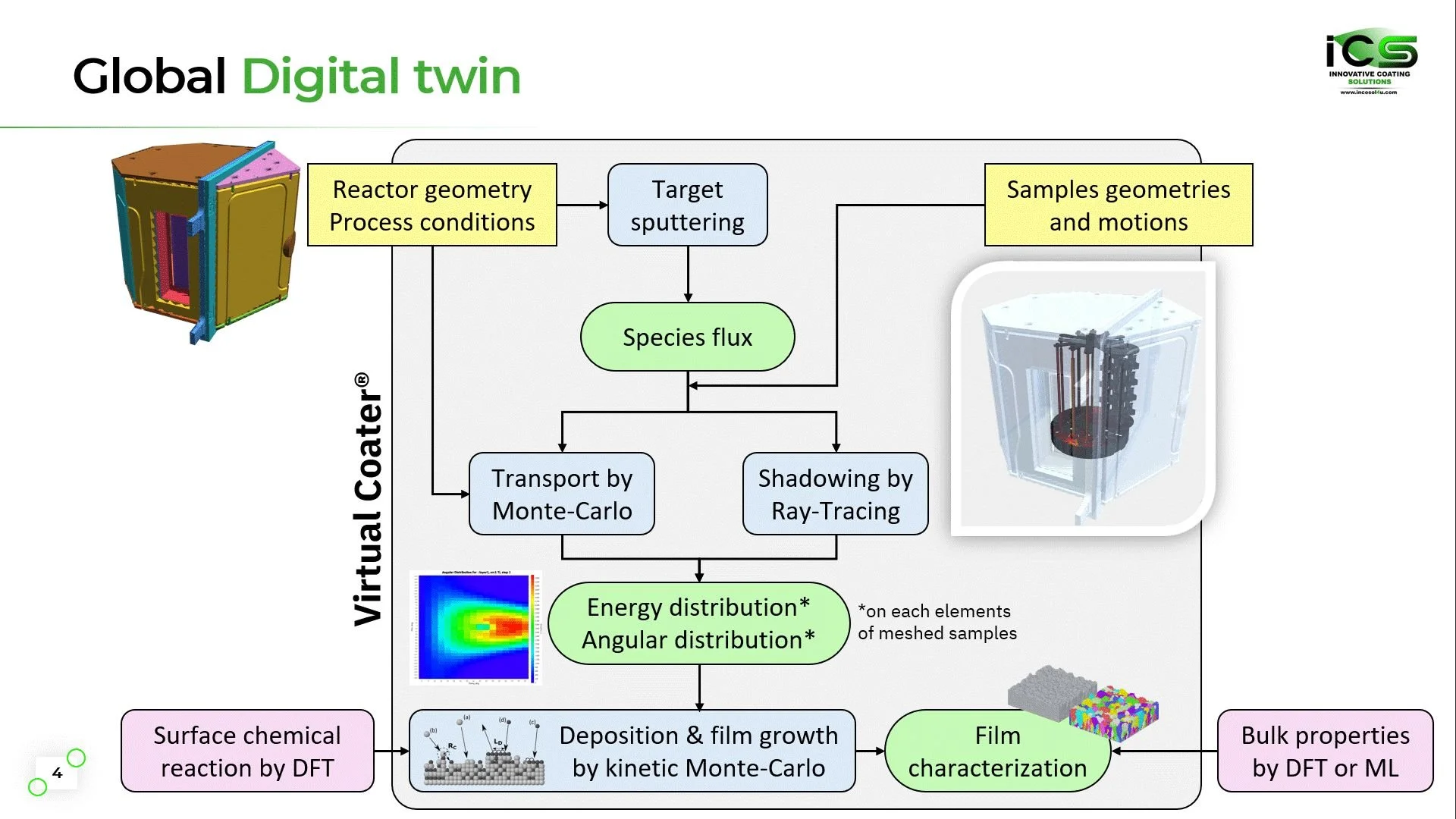
The connections between physical equipment and a digital twin. Courtesy of ICS.
Before a piece of equipment is engineered, a virtual representation can be created to address important questions: what components must be used and how should they be arranged in the vacuum chamber to obtain coatings on the substrates of interest with the throughput and film uniformity required for the application? The virtual realization of the core components (sputtering guns, evaporators, substrate stages, ion guns, etc.) come into being before the physical equipment, retiring much of the risk, particularly in new designs.
For existing equipment, the virtual counterpart can be used to predict the outcome of a process for the components in a particular configuration. As an example, is the required thickness uniformity met at a certain gun tilt angle and target-substrate distance combination in sputtering with a gun of a certain size? This is an example of controlling a macroscopic property. Microscopic properties such as film porosity or deposition into 3D features (e.g. trench-filling) can also be predicted, allowing the researcher to get a virtual head start on optimizing a film for its use. In this case it is an aid in experiment planning. Software such as Virtual Coater ™ [2] (created by an AJA customer – see below) can predict these properties.
Virtual tools can readily provide exposure to real-world equipment for educational purposes. Virtual Reality (VR) models of equipment give students the opportunity to interact with a representation of tools that would be inaccessible otherwise. Our customer at Cornell University developed an entire VR Digital Classroom [3] for this.
A digital twin in the fullest sense is connected to the real-world equipment via sensors that monitor the tool operation. The actual status and progress of the physical process is mirrored in the twin. This enables it to report status and allow decision-making midstream. A coupled Artificial Intelligence (AI) could further run simulations and models, command its physical counterpart to carry out processes, and then monitor progress in real time with little to no human intervention.
At whatever level of complexity – virtual machines or digital twins – these are tools for saving time, saving money, supporting decision-making, and furthering integration with AI for autonomous discovery.
AJA Deposition Systems and Digital Twins
Magnetron Sputtering Sources:
AJA International systems offer configurations for mounting several magnetrons, in either sputter up or sputter down orientation. The ATC Series can support up to 13 guns in combinations of confocal, direct, and off-axis sputtering geometries for exploring large material spaces. The Orion series can mount up to 8 guns. Co-deposition with up to 9 power supplies gives access to an extensive compositional space. A virtual machine can provide modelling and control of many guns to reach an optimal coating quickly.
Process Gas Delivery:
The system supports up to four mass flow controllers (MFCs) for precise regulation of process gases. Typical gases used include Ar, O₂, and N₂, allowing for a wide range of reactive and inert sputtering processes. Other gases can be provided. A gas ring can be included at the substrate for reactive deposition of oxides and nitrides. Non-local delivery is also available, so that all guns share the same process gas pressure.
Power Supply Options:
DC, pulsed DC, RF and HiPIMS supplies can all be configured into the system. AJA’s standard Phase II-Au control system will accommodate up to five DC power supplies with integral 4-way switchboxes, four RF power supplies, and one 4-way RF switchbox. This allows maximum flexibility for co-deposition from a large selection of sputter guns so that new material systems can be rapidly developed. Microscopic level simulations can apply the energy, spatial, and angular distribution from variously operated sources to predict and understand film morphology.
Substrate Holder:
The substrate holder is highly configurable, supporting sample sizes ranging from small coupons to full wafers up to 6” (Orion) or 12” (ATC) diameter with excellent film thickness uniformity. Available functionalities include high-temperature substrate heating (up to 800–1,000 °C), cryogenic (LN2) or water-based cooling, substrate rotation for uniform film growth, motorized Z-axis motion, and RF/DC substrate biasing for advanced process control.
Combinatorial Substrate Holder:
Combinatorial deposition driven by AI is a proven application of virtual tools. AJA’s combinatorial substrate holders build upon our robust standard designs and are enhanced with UHV-compatible X/Y stepper motor-driven bellows mechanisms. These holders accommodate multiple discrete samples on a single substrate, with common configurations including 5×5 and 10×10 arrays of 5 mm specimens (25 and 100 samples, respectively). An integrated automated masking system—with interchangeable apertures—allows flexible specimen sizing and isolation. The mask assembly can be retracted for gradient film deposition or confocal sputtering geometries with substrate rotation for uniform coatings.

Example ATC gun configuration

Example Orion gun configuration
Deposition Recipe Generator:
The software makes it simple to create and store up to 100+ recipes for depositing layer stacks. It is easy to write extensive recipes via the GUI – no coding required. Recipe operation automates the entire deposition process, with auto-abort in case setpoints fail to be reached. The Process Emulator Excel spreadsheet format allows line-by-line layer creation to represent even extensive processes in a single file. The Emulator structure allows computer model or AI-based generation of recipes, for direct loading into the Phase II-XS operating system software. This powerfully accelerates compositional space search capabilities.
High Vacuum and Ultra-High Vacuum Designs:
Our systems are engineered to achieve base pressures ranging from the low 10⁻⁷ Torr to the low 10⁻¹⁰ Torr regime. Systems can be constructed using all-metal seal vacuum chambers, and in-house manufactured bakeout jackets are available for thorough vacuum conditioning and system degassing.
Nanometer-Precision Film Thickness Control:
An optional quartz crystal monitor and controller allows calibration of deposition rates, which is key for creating alloy films with designed compositions. High-stability power supplies provide precise, repeatable deposition rates, while recipe-driven automation ensures accurate, repeatable process execution. A central substrate-facing port can also house in-situ probes for feedback of data to a remote host for real-time monitoring and analysis.
Vertically Integrated System Design:
AJA International manufactures many of the components in the systems. This ensures compatibility and quality, while controlling tool costs. This also speeds up service and provides long service life for the systems.

ATC Flagship System
Performance
An application of digital twins for data interpretation can be seen in work of Professor Stéphane Lucas (University of Namur, founder of Innovative Coating Solutions) and co-workers [4]. They explored the creation of silicon carbide coatings by magnetron sputtering, aiming to create dense, hard, oxidation resistant films. Sputtering is a simple technology that offers industrial scalability. Increased density improves coating hardness, while decreased roughness reduces oxidation rate. Therefore, the effect of (Si) substrate bias was studied experimentally and also in a digital twin designed in Virtual Coater™. The effect of substrate bias is seen in the figure below, which represents the virtual deposition of one million deposited atoms. The density increases (smaller volume) for increased bias, and the surface roughness decreases.
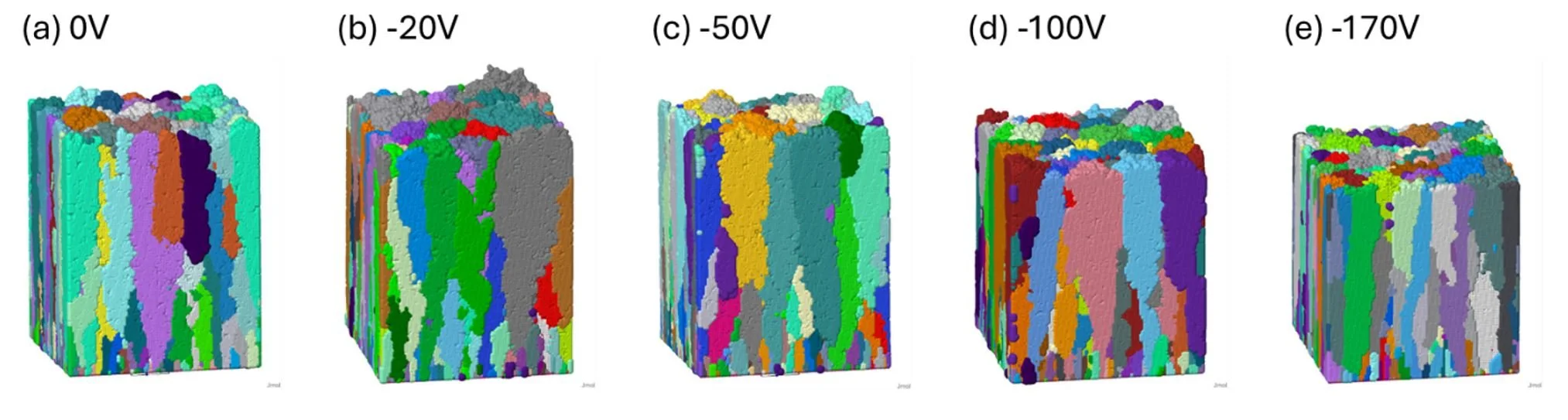
Effect of substrate bias on simulated SiC coatings
Observe also the dense columnar grain structure of the film deposited at −100 V bias. For −170 V bias the virtual film has a density 98% of bulk SiC, but the compressive stress is becoming high, leading to risk of delamination. Therefore, a combination of experiment and simulation recommends −100 V for optimal properties. Finally, the figure below shows an SEM cross section of such a film, after thermal annealing for 62 h at 900 °C. The film has a dense, columnar structure and resists excessive oxidation.
The two-way correspondence between physical experimentation and the digital twin helps to elucidate the dynamics of thin film growth and point to optimal outcomes.
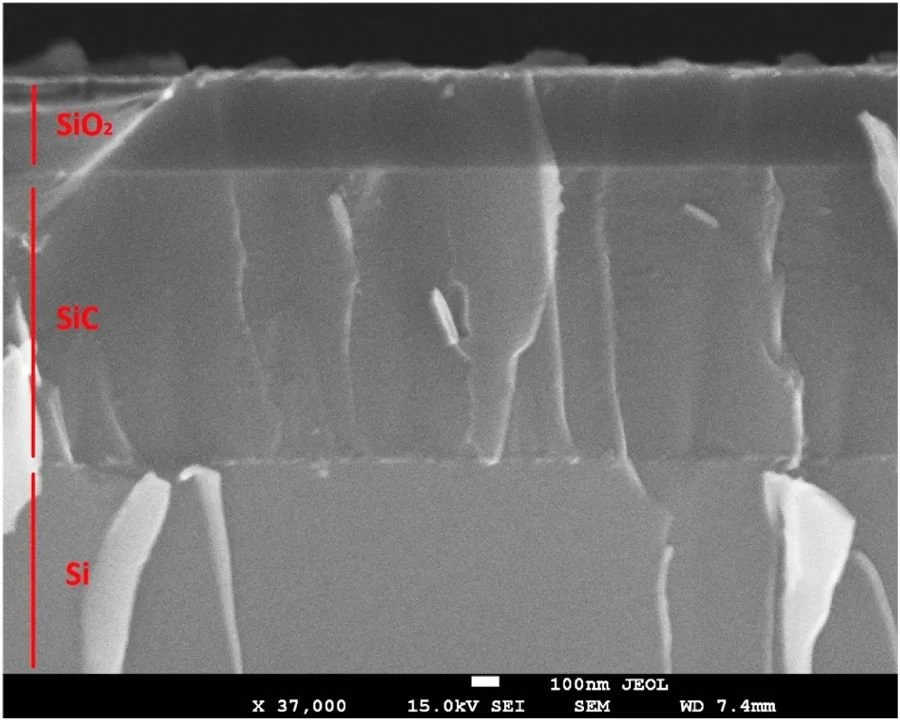
Effect of substrate bias on simulated SiC coatings

AJA International’s applications team is regularly updating our library with comprehensive process notations. Check in here weekly for new and exciting information.
To explore how AJA systems can advance your materials science research, contact our sales team today.